


Professional cleanup buys three things a rented fan just cannot. Moisture gets found inside the structure, drying gets verified against a reading, and the claim gets a documented file. A household cleanup dries what you can see and leaves the wall cavity to sort itself out, which in Central Florida it really does not.
Our crews at United Water Restoration Group of Orlando provide premier water damage repair in Orlando, FL, for homes and businesses across Orange County. Certified technicians go out at any hour, and every job opens with a free in-home visual assessment.
You see the moisture map before committing to anything, which is kind of the point. The difference shows up a month later, in whether the room still smells right.
What a Do-It-Yourself Cleanup Leaves Behind
Surface water is the easy part, and a shop vac handles it perfectly well. The water that causes expensive problems has already moved into the subfloor, up the back of the drywall, and into the insulation. No amount of airflow across a room reaches it, no matter how long the fans run. Materials read dry to a hand and stay wet inside for weeks, which is the sneaky part.
Orlando’s climate removes the margin for error a drier region would give you. Ambient humidity stays high through most of the year, so wet building materials have nowhere to release moisture to.
The structure just holds it, and growth follows. Plenty of homeowners clean up thoroughly and still end up with a problem behind the baseboard. Meters and thermal imaging catch that early, which is just what a water damage inspection covers.
How a Professional Job Is Sequenced
Order matters a bit more than equipment, honestly. Drying a room while the source still runs wastes several days. Every job we take, commercial water damage restoration included, runs through the same four stages.
- Emergency response and damage review. The crew traces the water to its source, flags hazards, and maps how far it traveled using thermal imaging and moisture meters.
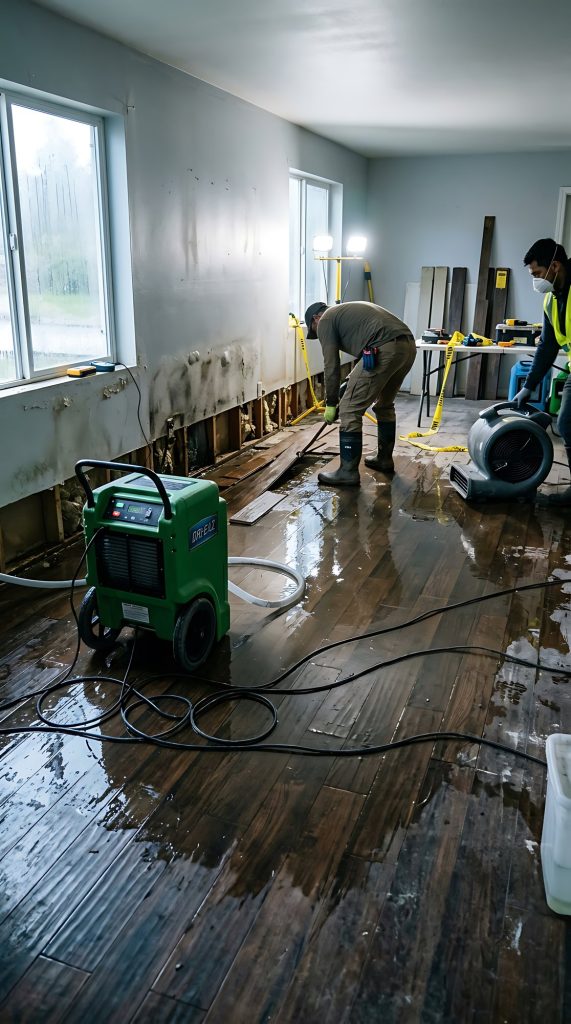
- Water removal and structural drying. Truck-mounted extraction pulls standing water out before anything else. Air movers and dehumidifiers then drive moisture out of framing, subfloor, and wall cavities.
- Cleaning and sanitization. Affected areas get cleaned and treated, porous materials are addressed, and odor is handled at the source rather than masked.
- Repair, reconstruction, and full restoration. Drywall, flooring, paint, and cabinetry go back in, and larger losses move into structural repair.
Stage two runs on readings rather than on a schedule, usually across three to five days. Equipment stays until the affected materials match a dry standard taken from unaffected material elsewhere in the building. That is a measurable finish line, you know, rather than a judgment call.
Standing water now, or a floor that has felt wrong since last week? Call us any hour at (407) 278-7715, and our Orlando crews will send a certified technician to map the moisture before you decide what to do about it.
What Documentation Does for Your Claim
Insurance outcomes turn on the file more than on the damage, which surprises a lot of people. A carrier wants the cause, the date, the extent of the loss, and evidence it was addressed quickly.
Photographs taken partway through a cleanup rarely cover all four. We photograph each affected area at the assessment and record moisture readings daily through the drying period. The file just stays open until the work closes.
We bill carriers directly, including State Farm, Allstate, Nationwide, and Progressive. That keeps the paperwork on our side of the job, which is a big part of what businesses should know about commercial restoration.
It is worth more than it sounds in the week after a storm, when adjusters are working a backlog. Coverage decisions belong to your carrier, and a well-documented loss gives that decision something solid to rest on.
Where Commercial Properties Are Different
A closed business loses more to downtime than to the repair, and that is kind of the whole story. The sequencing changes as a result. Work gets staged so part of the building reopens while the rest finishes, and crews run nights and weekends where operating hours demand it. Tenant access, shared walls, and building management all shape the plan before equipment goes in.
Our commercial restoration teams handle offices, restaurants, warehouses, and managed portfolios across Orange County on that basis. Those considerations apply whether the damage came from a roof, a riser, or a kitchen line.
What You Are Actually Paying For
Equipment is the visible part and the smallest part of the answer. Truck-mounted extraction, commercial dehumidifiers, and thermal imaging do work that rented gear cannot. Any company can buy equipment, though.
What changes the outcome is the technician. Someone who categorizes the water before deciding what gets saved, and tracks readings instead of guessing at a timeline. Someone who knows which cabinet to open before any other.
The rest is single ownership of the job. Mitigation, mold work, and reconstruction all sit with one company here. Nobody hands a half-dried building to a contractor and argues later about what was wet. Property managers across Orlando, Florida rate this branch 4.9 stars on Google.
The recurring themes are speed of arrival and whether the technician explained what was happening. Anyone weighing one contractor against a split scope tends to see the trade-offs pretty quickly, usually when the invoices start arriving.
A free assessment costs nothing and settles the question. Contact us or call (407) 278-7715, and a certified technician will tell you whether this is a weekend job or a restoration job before you spend anything.
Related Topics: