


Water damage rarely happens on a convenient schedule, and most homeowners in Orlando have no idea what happens between that first phone call and the day their property is back to normal. It is, kind of, one of those situations where not knowing what comes next makes everything feel harder than it has to be.
At United Water Restoration Group of Orlando, we find that understanding the stages involved and roughly how long they take makes an already stressful situation feel a lot more manageable. Every job looks a bit different depending on how much water was involved and how long it sat. But the core process our team follows stays consistent from one property to the next.
Below is a walkthrough of what to expect at each stage, from the moment you notice standing water to the final walkthrough confirming your property has been returned to its pre-damage condition. You know, reliable water damage restoration services make that whole process a lot less overwhelming when you have the right team guiding you through it.
The Initial Call and What Happens Before a Technician Arrives
When you call in a water damage emergency, our first priority is gathering enough detail to understand what you are dealing with. Our team asks about the water source, whether it is still leaking, and whether it's clean (like a supply line) or contaminated (like a sewage backup), since that affects how we handle the job from the start.
This conversation helps us prepare the right equipment before a technician arrives. Knowing what to expect at this stage is often the first reason people decide to hire a water restoration company rather than try to manage the situation alone.
While you wait for a technician to arrive, shut off the water source if you can reach it to prevent the situation from getting worse. Moving furniture and personal items away from standing water helps limit how much gets damaged before drying equipment is in place.
We offer a free in-home visual assessment as the starting point for every water damage job, so there is no cost involved in having someone come take a look.
- Shut off the water source if you can safely reach it
- Move furniture and personal items away from standing water
- Avoid walking through standing water near outlets or appliances
- Take photos of the damage before cleanup begins
| Stage | What Happens | Typical Duration |
|---|---|---|
| Initial call and assessment | Technician evaluates the source, category, and scope of the damage | Same day |
| Extraction | Standing water removed with pumps and wet vacuums | Hours |
| Structural drying | Air movers and dehumidifiers dry materials in place | 3 to 5+ days |
| Repair and reconstruction | Damaged materials replaced and the property rebuilt | Varies by scope |
| Insurance coordination | Documentation shared with the carrier throughout the job | Ongoing |
What Happens During a Water Damage Assessment
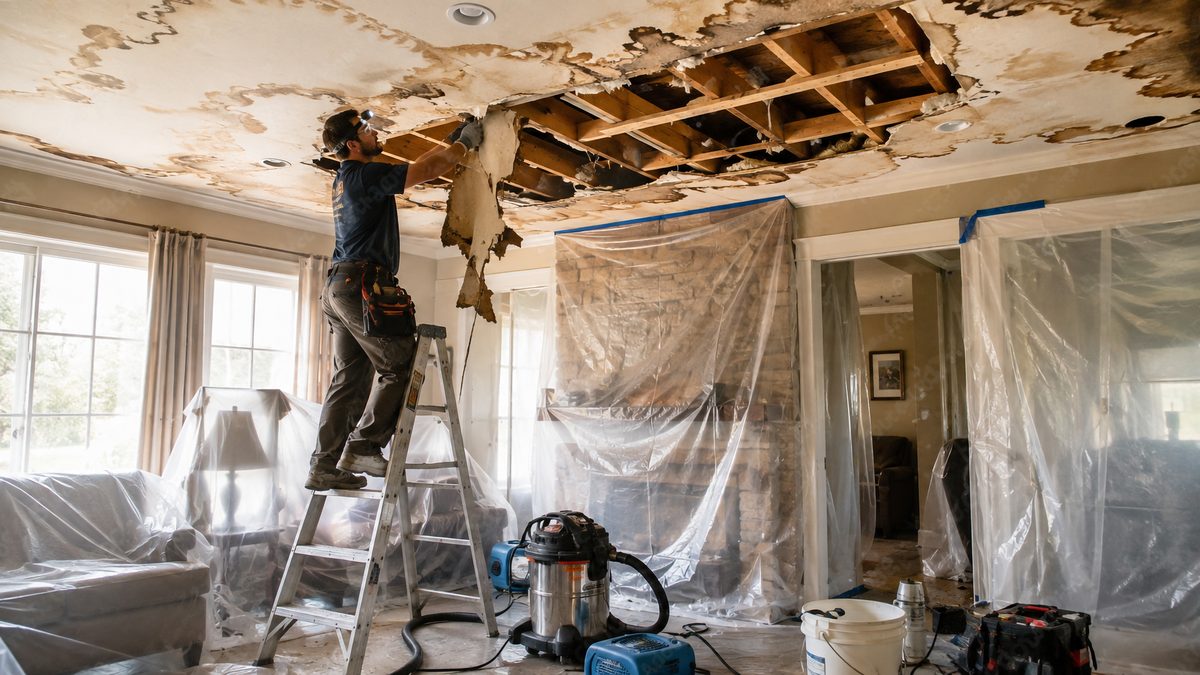
Once a technician is on site, the assessment goes well beyond a quick glance at the visibly wet areas. Moisture meters and thermal imaging check inside walls, under flooring, and behind cabinets, since water often travels far beyond what is obvious on the surface.
This matters because treating only the visible damage while leaving hidden moisture behind almost always leads to mold growth or warped materials down the road.
The technician explains what they are finding and why certain areas need attention, so you are not left guessing about what happens next. This is also when the water category gets confirmed, since clean water, grey water, and contaminated black water all require different handling.
The assessment leaves you with a clear picture of which areas need extraction, which need drying, and what needs to be removed.
How Extraction and Structural Drying Work
Extraction is the first hands-on step in the restoration process, using pumps and wet vacuums to remove standing water from floors and other surfaces. This happens quickly because the longer water sits, the more it soaks into subflooring and drywall, which become much harder to dry once fully saturated.
Once visible water is removed, the focus shifts to moisture already absorbed into building materials. This is typically the phase where full water damage restoration in Orlando work becomes most visible, since equipment stays running around the clock.
Structural drying is the phase most people underestimate, since it often takes several days of air movers and industrial dehumidifiers running to pull moisture out of drywall, framing, and subfloors.
Our technicians monitor progress with moisture readings rather than guessing when a space is dry, since removing equipment too early can leave hidden moisture that leads to mold later. This phase also includes evaluating the carpet to determine whether it can be dried and saved or needs to be replaced.
Standing water in your home or business right now? Call United Water Restoration Group of Orlando at (407) 278-7715. We answer 24 hours a day, every day of the year, and start every job with a free in-home visual assessment.
Repair and Reconstruction After the Property Is Dry
Once moisture levels confirm a space is fully dry, attention shifts to repairing whatever was damaged. This can range from replacing a section of drywall to a larger project involving flooring or cabinetry that could not be saved. Handling this phase with the same team that managed extraction and drying means there is no gap where the property sits half-finished while you search for a separate contractor.
Reconstruction work is scheduled based on what the assessment and drying phases revealed, and our team walks through the scope of that work with you before anything begins. For smaller losses, this might involve patching and repainting a single wall.
For larger events involving flooding or extended exposure, it can mean replacing subflooring or built-in cabinetry that absorbed too much moisture to be salvaged. Either way, the goal stays the same, returning the property to its condition before the damage occurred.
How Insurance Coordination Fits Into the Restoration Timeline
Most Orlando homeowners dealing with water damage are also working through an insurance claim, and that process runs alongside the physical restoration work.
Our team documents the damage thoroughly at each stage, since that documentation is often what an adjuster needs to process a claim efficiently. Working directly with major carriers means less back-and-forth falls on you as the homeowner.
Insurance involvement typically increases once damage has been assessed and documented and continues through the claims process as remediation and repair work move forward.
Coverage depends on the cause of the water damage and your policy's specific terms, so confirming exact coverage details directly with your carrier remains a worthwhile step, no matter how the restoration work is going. Keeping the lines of communication open between your restoration team and your insurance provider tends to keep the process moving more smoothly.
What Determines How Long the Process Takes
There is no single timeline that applies to every water damage job, since the length of the process depends heavily on how much water was involved and how long it sat before treatment began. A contained leak caught early, such as a supply line failure addressed the same day, might dry out within a few days with minimal repair work needed afterward.
A larger event, like flooding that affects multiple rooms or sits for an extended period before anyone notices, can take considerably longer to dry fully and may involve more extensive reconstruction.
Other factors that affect timing include how many materials need to be replaced rather than dried, whether mold growth has already started, and how quickly insurance approval moves once a claim is filed. Because every property and every water event is different, our team focuses on giving you realistic expectations at each stage rather than a single estimate at the start, so you know what is happening and roughly what comes next.
Frequently Asked Questions
How long does the water damage restoration process usually take?
A contained leak caught early may dry out within a few days, while larger losses involving multiple rooms or extended exposure can take considerably longer. Your technician gives you a realistic timeline once the assessment is complete rather than a single estimate upfront.
Will the same team handle both the drying and the repairs?
Yes. United Water Restoration Group of Orlando manages mitigation, structural drying, and reconstruction under one roof, so you are not searching for a separate contractor once the property is dry.
Do I need to stay in my home during the restoration process?
In many cases, yes, especially for smaller, contained losses. For larger losses involving significant structural drying or repair work, a technician can advise whether temporary relocation makes sense.
Our IICRC-certified technicians are available 24 hours a day for a free in-home visual assessment, and we work directly with major carriers to make the claims process easier. Call (407) 278-7715 to get started.