



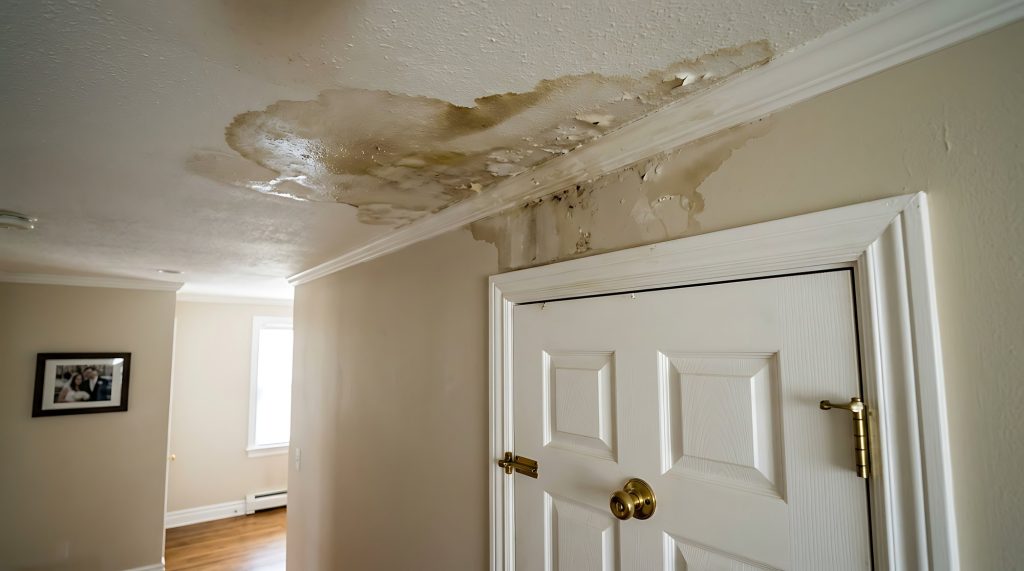
Drywall tells on a leak in a set order. A faint discoloration leads off, then a stain with a defined edge, then softness, bubbling paint, nail pops, and a musty smell. Each stage marks roughly how long water has been present, which is why a wall is worth reading rather than just patching.
Our team has provided certified water damage repair services across Jacksonville since 2011, and our IICRC-certified technicians meter a wall before touching it. Just press a thumb gently on the center of any stain. If the surface gives even a bit, the gypsum core has taken on water, and paint is not the fix.
How Drywall Shows Damage Before Anything Else Does
Drywall is a gypsum core wrapped in paper, and both parts react to moisture quickly. The paper facing wicks water sideways, kind of like a paper towel.
That is why stains spread wider than the leak itself, and why the visible mark rarely sits directly under the source. Water entering at a roof penetration is the classic heavy rain and water damage risk, and it can appear on a wall eight feet away, following a top plate until it finds a path down.
That sideways travel makes drywall a useful early indicator but a poor locator. A homeowner looks at a stain and, reasonably, assumes the problem sits right behind it.
Our crews read the wall in a grid instead. We take readings outward from the stain until the numbers drop back to normal. The wet area is almost always larger than the discolored area, and occasionally it sits somewhere else entirely.
The Signs Our Crews Check Right Away
Walking a property, we read for a sequence rather than just one symptom. One sign on its own can have an innocent explanation, sure. Two or three together, in the same area, almost always means active or recent moisture inside the assembly.
- A stain with a hard brown edge, marking where water stopped and dried repeatedly
- Paint bubbling or blistering, meaning water is behind the paint film
- Nail or screw pops in a line, as gypsum softens and loses grip on the fastener
- Softness underneath, where the core has lost its structure
- Seams or tape lifting, especially at an inside corner or a ceiling joint
- A musty smell that strengthens when a nearby closet or cabinet opens
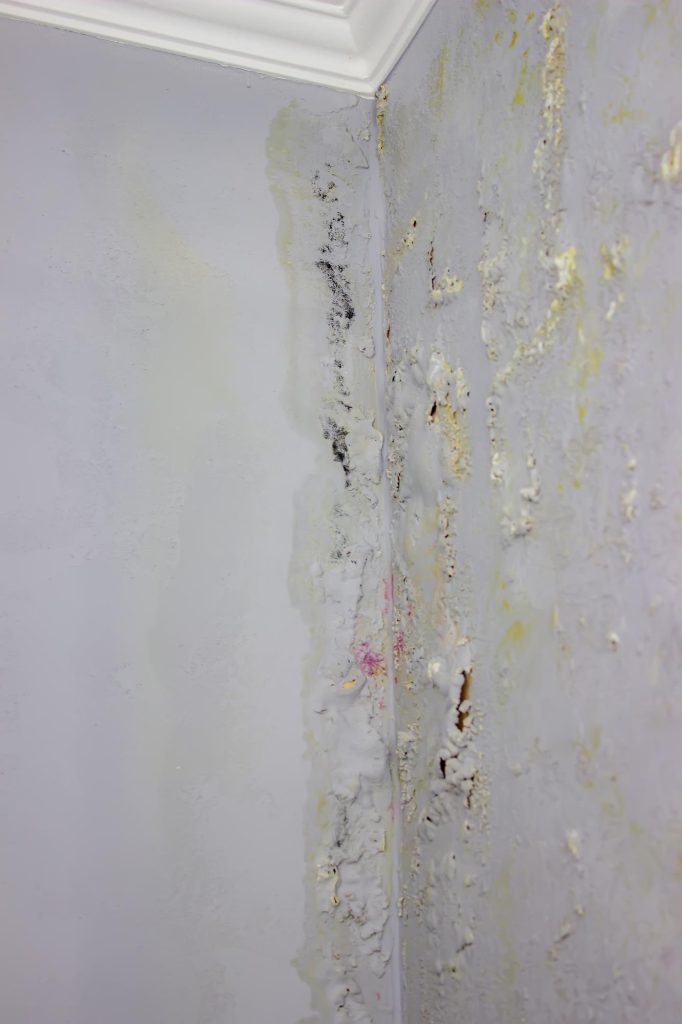
Ceilings run through this sequence faster than walls. Gravity keeps water pooling in one place rather than draining down, you know. Spotting the warning signs of ceiling water damage, like a sagging plane, tells you when a room should be cleared.
What a Stain Tells You About Its Source
Stain color and shape carry usable information once you know what to look for. The distinction matters, because it changes the urgency and sometimes the trade that gets called.
| What you see | Likely source | What it means for the repair |
| Yellow-brown ring, dry, hard edge | Old leak, already stopped | May need sealing and paint only |
| Dark, damp, soft center | Active leak | Find the source before any repair |
| Gray or black speckling | Prolonged moisture, growth present | Material removal, not surface work |
| Stain directly below a fixture | Supply or drain connection above | Plumbing repair precedes drying |
| Stain at floor level, rising | Wicking from a wet subfloor | The floor assembly is the problem |
A stain at floor level rising upward is the one homeowners most often misread. Drywall wicks moisture upward from a wet bottom plate, so a band of discoloration a few inches above the baseboard points downward to the floor, not outward to the wall. A thermal imaging inspection helps in cases like this, where the visible evidence and the real source sit in different places.
If you’ve noticed a band like that along your baseboards in Jacksonville, give us a call at (904) 312-7990, and we’ll take a look before it turns into a bigger problem.
Why Jacksonville Humidity Changes How Drywall Behaves
A wall dries by releasing moisture into the air around it. That process slows as the air gets more humid. Our climate keeps indoor relative humidity high through much of the year.
A drywall assembly that got wet here holds water far longer than the same assembly would in a drier region. Walls that would air-dry on their own elsewhere just do not here.
Heavy rain compounds it. A wind-driven storm can push water past siding or around window flashing. The back of the drywall soaks while the painted face stays perfectly dry for days. Once a stain appears on the finished side, the cavity has been wet through an entire humid week.
That delay is why our crews meter exterior walls after a storm, even when nothing inside looks wrong. A wall that was fine on Monday can show a stain the following weekend. Insulation in the cavity makes it slower still, holding water against the sheathing where no airflow reaches it. Nobody really sees any of that until the stain finally shows up.
When Drywall Can Be Dried and When It Has to Come Out
Drywall is more recoverable than most people assume. Water present for a short time, in a wall with no insulation holding it, often dries in place with directed airflow and dehumidification. The wall gets repainted rather than rebuilt. Our technicians make that call from meter readings taken over consecutive days, watching whether the numbers actually fall.
Removal becomes the answer in three situations. A core that has lost structure will not regain it, so anything soft or crumbling comes out. Insulated cavities that stay wet behind an intact face cannot be dried through the drywall. We cut low on the wall to open the cavity instead.
Growth on the paper facing means the material is compromised, and surface cleaning does not reach what has colonized the paper. In those cases, we cut back to a clean, dry, measurable boundary. Cutting to the edge of the visible stain is not enough, because the stain underreports the wet area almost every time.
If you are seeing any of the signs above in a Jacksonville property, contact us for a free assessment. Our certified technicians respond around the clock, year-round, so call (904) 312-7990 or visit us at 9556 Historic Kings Rd S STE 404, Jacksonville, FL 32257.
Related Topics: