



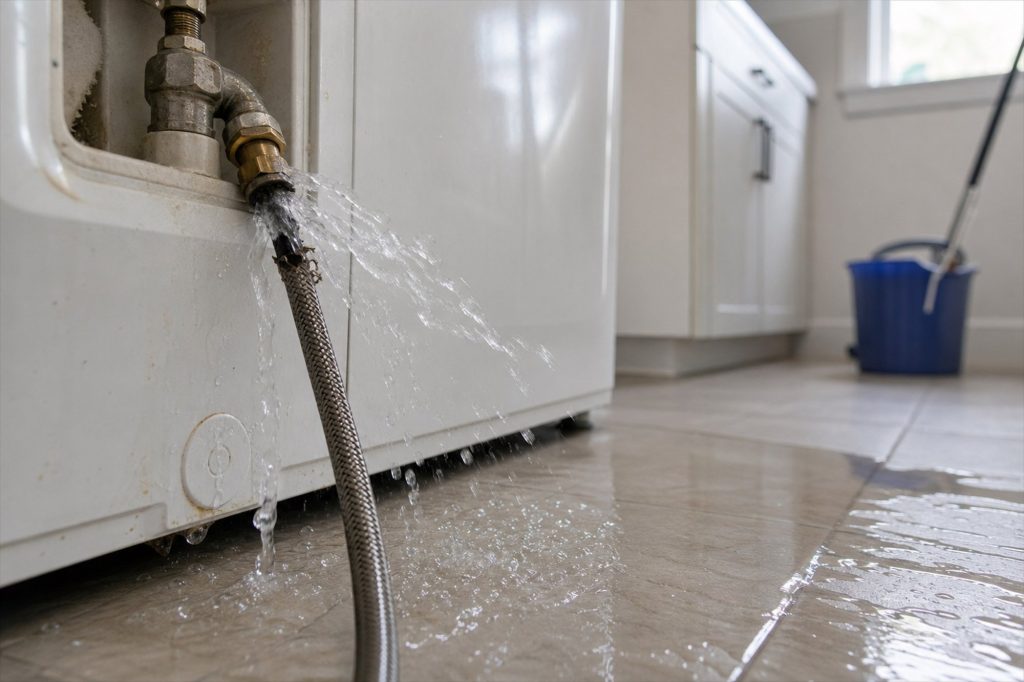
An appliance leak does its damage underneath the appliance, where nobody looks until the floor moves. A washer supply hose, a dishwasher inlet valve, an ice maker line, and a water heater tank all sit against flooring and drywall. All four fail without warning.
As a licensed water damage repair company in Jacksonville, FL, we have worked these losses since 2011, and our IICRC-certified crews find the same pattern most of the time. A small volume of water runs for a long stretch into material that cannot drain.
Pull your washer forward once a year and look at the braided hoses, you know, just a quick peek. A bulge or a rust bloom at the crimp means it is already on borrowed time.
Why Appliance Leaks Do More Harm Than a Burst Pipe
A burst pipe is loud, fast, and obvious, and it gets a phone call within the hour. Appliance leaks work the opposite way. The volume is low enough that nothing pools where anyone would walk, and the appliance keeps running normally the whole time. There is no performance problem to prompt a service call, so nobody really thinks about it.
That difference decides how much of the house is involved by the time we arrive. Fast losses are usually wide and shallow, so water mitigation mostly means extracting and drying water across a floor. Slow appliance losses go deep and narrow, which is a different animal. They saturate the subfloor under one appliance and wick up the back of a drywall wall.
From there, the water travels along a joist into a room with no appliance. The homeowner points at the laundry room, and we end up reading moisture in the hallway.
Which Appliances Fail Most Often in Jacksonville Homes
Each appliance fails in a characteristic way. Knowing which one it is, maybe even from a quick look, tells us where the water went before we open anything. A pressurized supply failure runs whether or not the appliance is in use. A drain or seal failure only releases water during a cycle, which is why some go undetected for months of light use.
| Appliance | Typical failure | What it reaches early |
| Washing machine | Braided supply hose at the crimp | Drywall behind the unit, then subfloor |
| Dishwasher | Inlet valve or door gasket | Subfloor under the cabinet run |
| Refrigerator | Ice maker line or saddle valve | Flooring that extends under the unit |
| Water heater | Tank corrosion or relief valve | Slab, baseboard, adjoining wall cavity |
| Washer drain | Standpipe overflow during a cycle | Floor across the whole laundry room |
Water heaters deserve separate attention, because the failure mode is different. A tank does not usually drip for weeks. It corrodes quietly for months, then releases most of its volume at once.
A unit in a garage or utility closet sits against living space. Water pushes through the wall plate and into the next room’s carpet before anyone is home to see it, and drying wet carpet gets harder with every hour it sits.
What a Slow Appliance Leak Does to a Floor Over Time
Flooring assemblies are built to shed water from above, not to hold it from below. Once water sits on a subfloor, it moves outward through the sheathing and upward into whatever sits on top. Engineered flooring and laminate swell at the seams and lift at the edges. That lifting is usually the earliest visible evidence, and it appears a few feet from the appliance rather than beside it.
Hardwood behaves differently and is often recoverable. That surprises homeowners who assume a wet floor is a torn-out floor. Boards cup because the underside absorbs moisture faster than the finished face. If drying starts soon enough, the cupping can reverse. That window makes saving hardwood floors after water damage a realistic goal in many homes.
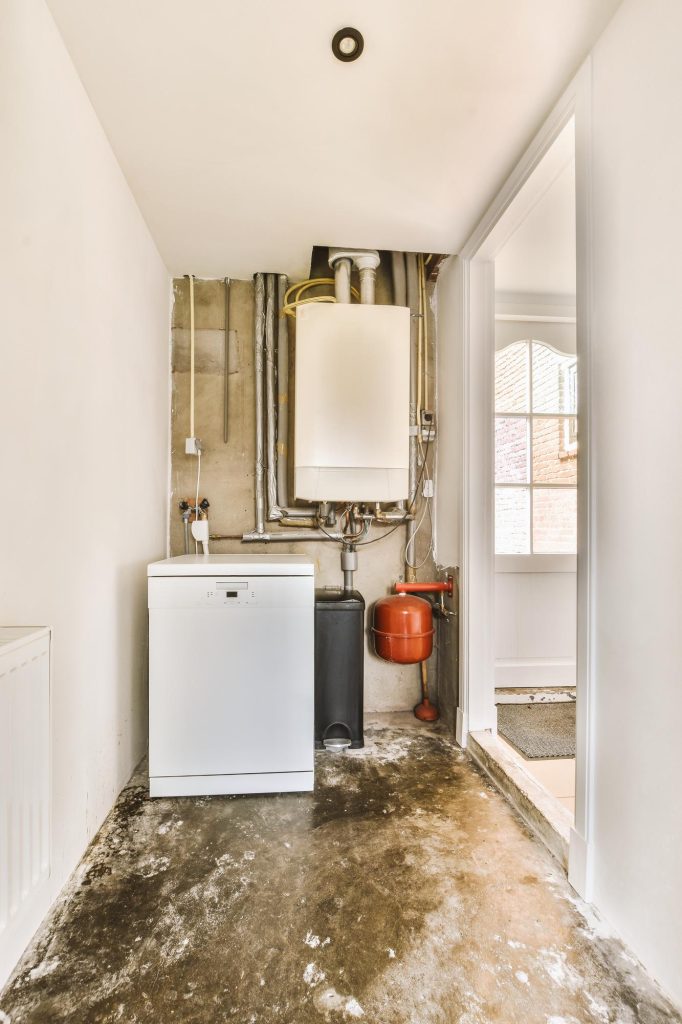
Carpet and pad are a separate judgment again. The pad underneath holds far more water than the carpet face does, and it releases that water slowly. The pad is almost always what decides whether the floor covering stays or goes, and that is just how it works.
Florida humidity shortens every one of these timelines, because wet material stays wet longer when the air has little capacity left to absorb it. Mold growth can begin on wet organic material within 24 to 48 hours, and a subfloor under a dishwasher is exactly that in a warm, dark, enclosed space.
Noticed a lifted seam or a soft spot near your washer or dishwasher? Give us a call at (904) 312-7990, and we’ll take a look before it turns into a bigger problem.
How Our Crews Find Water an Appliance Has Already Hidden
Thermal imaging goes on the wall before anything else. It shows temperature differences across a surface, and wet material reads colder than the dry material around it. That gives us a shape to work with, a rough boundary of where moisture traveled behind cabinets and inside walls. Thermal imaging suggests. It does not confirm, which is why it is never the last step.
Moisture meters confirm readings at specific points, and those numbers define the scope. Our water mitigation work starts from that map. We extract what can be extracted, then place air movers and dehumidifiers to pull moisture out of the materials that stay. We take readings again daily, because a drying plan that isn’t measured is just equipment sitting in a room.
Appliance losses often involve toe kicks and wall cavities that need small access holes drilled, so dry air reaches the inside of the assembly. That is a far smaller intervention than replacing a cabinet run six weeks later, you know.
What Homeowners Can Check This Season
Most appliance losses we respond to were preventable at the hose or the valve. These checks take under half an hour across the whole house, and they catch the failures that cost the most.
- Replace braided washer hoses every five years, regardless of appearance
- Shut the washer supply valves when leaving town for more than a few days
- Look under the dishwasher door for staining on the floor at the cabinet edge
- Check the refrigerator line at the saddle valve for mineral crust or corrosion
- Note the water heater’s age on its label and watch any unit past ten years
Laundry rooms deserve the closest attention of the five. A standpipe overflow puts water across an entire floor rather than into one cabinet. Carpet in an adjoining hallway wicks that water under the threshold within minutes. The pad is usually soaked before anyone notices.
Act Fast When an Appliance Lets Go
Start by shutting off the supply to that appliance, then the main if the valve will not move. Unplug the unit if water has reached the cord. If that means standing in water to reach the outlet, leave it and cut power at the panel instead. Photograph everything before you mop.
Then call us, because an appliance leak that has run for weeks has already moved past what a shop vacuum resolves. The difference between a three-day drying job and a cabinet replacement is usually how fast somebody measured the subfloor.
Not sure where to start, or just want to talk through your options first? Contact us, and we’ll help you figure out the right next step, or call us at (904) 312-7990. Our crews at 9556 Historic Kings Rd S STE 404, Jacksonville, FL 32257 are available 24/7, 365 days a year, and we bill insurance carriers directly.
Related Topics: