


Extraction removes the water you can see. Structural drying removes what has soaked into framing, subfloor, drywall, and insulation. That second part is where a restoration succeeds, or kind of quietly fails. We have built our professional Jacksonville water damage repair services around that distinction since 2011.
Our IICRC-certified technicians call a job finished only when readings hold steady across consecutive days. A floor that feels dry underfoot on day two really tells you nothing about the subfloor beneath it.
What Structural Drying Actually Removes
Building materials are porous. They absorb water into their structure rather than holding it on the surface. Framing lumber, sheathing, gypsum core, and fiberglass insulation all take water in and release it slowly, on their own schedule, not ours. Pumping standing water out of a room addresses just a fraction of what is actually present after a significant loss.
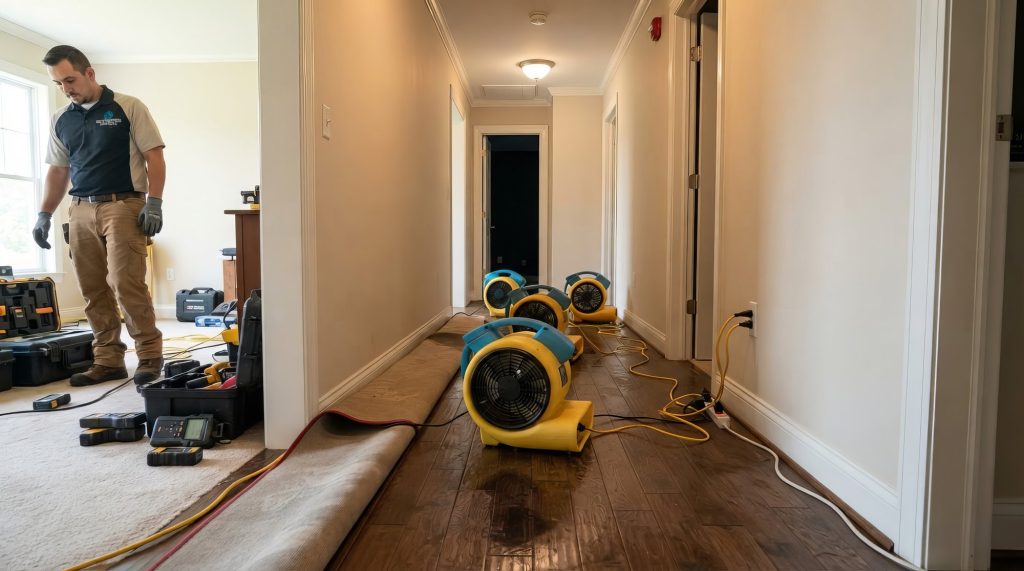
Structural drying is the controlled process of forcing that bound moisture back out. Professional dehumidification lowers the room’s humidity so the air has capacity to accept moisture. Air movers push that dry air across wet surfaces to speed evaporation.
The two work as a system, and one without the other does very little. That is why a homeowner running fans for a week often ends up with the same reading they started with. The fans just moved humid air around a humid room.
Why Surface Dry Is Not Dry
A floor can feel completely dry while the subfloor under it reads saturated. The finished surface lets go of its moisture early, and the assembly beneath it is the last.
That gap between what a hand reports and what a meter reports is where most failed restorations start, and what happens during an emergency water damage response in those early hours decides a lot about how wide it gets. The homeowner is satisfied, the equipment comes out, and the material underneath keeps holding water.
Mold growth can begin on wet organic material within 24 to 48 hours, and it does not require standing water, only sustained moisture. A subfloor sitting wet under an intact, dry-looking floor meets that condition exactly.
Wood framing that stays wet also loses strength, and it can warp or rot over time. Fasteners in wet material lose their grip. None of that is visible, at least not during the week the problem is still solvable.
How Our Climate Works Against a Drying Plan
Evaporation depends on the difference between the moisture in the material and the moisture in the air. Jacksonville’s humidity narrows that gap for much of the year.
A structure here dries more slowly than the same structure would elsewhere, and saving hardwood floors after water damage gets a bit harder for exactly that reason. Open windows frequently make matters worse, bringing humid outdoor air into a space we are trying to dry.
That is the argument for a closed drying environment, and it’s why our crews seal the affected area, run dehumidification to hold humidity down inside it, and direct airflow where the moisture actually is.
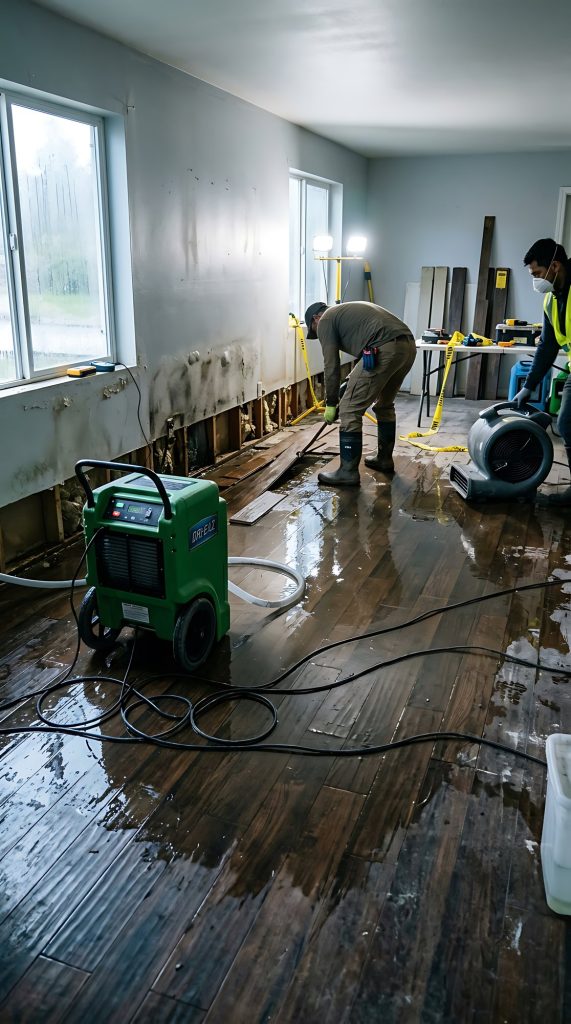
Our professional dehumidification equipment is sized to the volume of the space and the amount of water present. An undersized unit in a large room runs continuously and never wins, so placement gets adjusted as readings change.
Noticed a musty smell or a room that still feels damp in Jacksonville? Give us a call at (904) 312-7990, and we’ll take a look before it turns into a bigger problem.
What a Drying Plan Looks Like on a Job
Every piece of equipment on a job is there for a specific reason. The mix just changes depending on which materials are wet and how they are assembled.
| Equipment | What it does | Where it earns its place |
| Air movers | Speed evaporation at wet surfaces | Along walls and across flooring |
| Dehumidifiers | Remove moisture from room air | Centered in the sealed drying area |
| Injection drying | Force dry air inside a cavity | Wall cavities and under hardwood |
| Moisture meters | Confirm material moisture content | Daily readings at mapped points |
| Thermal imaging | Map the boundary of wet material | Opening visit, and before removal |
The readings drive the plan. Our technicians record moisture content at marked locations every day and compare the numbers. A reading that stops falling means something has changed. Usually, it is a cavity that airflow isn’t reaching, and that cavity needs to be opened. That opening visit sets the baseline for every number after it.
What Drying Properly Saves
Shortened drying does not announce itself for weeks, which is exactly the problem. The earliest sign tends to be an odor. Then a stain reappears through fresh paint, and flooring lifts after it was already repaired once. At that point, the repair work has to be undone to reach material that was never dried.
Drying to a documented standard protects more than the building. Insurance carriers want evidence that the property was returned to a dry, stable condition, and daily readings are that evidence.
A claim closed on documented numbers is far less likely to reopen as a disputed mold claim. That matters, because mold coverage is frequently limited in ways water damage coverage is not.
Hardwood shows what proper drying saves outright. Cupped boards dried quickly and correctly often flatten and keep their finish. The same boards left to dry on their own crack and get replaced. Same wood, very different outcome, and the only thing that changed is how it was dried.
If a Jacksonville property has taken on water, contact us or call (904) 312-7990 for a free assessment. Our certified technicians are available 24/7, 365 days a year, and you can find us at 9556 Historic Kings Rd S STE 404, Jacksonville, FL 32257. We bill insurance carriers directly, so documentation of the drying process goes where it needs to go.
Related Topics: