



A drying job without readings is a guess with equipment attached. Moisture meters turn the question of whether a wall is dry into a number that can be tracked day over day, which is the difference between a structure that stays dry and one that grows mold behind new paint. Our technicians put meters on every dehumidification service job in Jacksonville before a single air mover gets placed, because the readings decide where the equipment goes and how long it stays.
What a Moisture Meter Measures
Meters report how much water a material is holding, expressed either as a percentage of moisture content or as a relative scale depending on the instrument and the material. Wood and drywall hold water differently, so the same number means different things across them, and part of a technician’s training is knowing what a normal baseline looks like for each material in our climate.
That baseline is the whole point. Before drying begins, technicians take readings in an unaffected part of the property, usually a room the water never reached. That becomes the dry standard for the job. Everything in the affected area gets compared against it, and drying is finished when the wet materials come back to that same number rather than to an arbitrary target. Pairing meters with other tools is standard, and there is more on how professionals detect moisture across an affected structure.
Pin Meters and Pinless Meters
Two instrument types do different jobs, and crews carry both. Pin meters drive two probes into the material and measure electrical resistance between them, giving a reading at a specific depth in a specific spot. Pinless meters press a sensor pad flat against a surface and read a broader area without leaving marks, which is what gets used across finished walls, cabinetry, and hardwood where holes are unwelcome.
| Instrument | How it reads | Best used for |
| Pin meter | Resistance between two inserted probes | Framing, subfloor, confirming depth of saturation |
| Pinless meter | Surface sensor scanning below the finish | Finished walls, hardwood, cabinets, quick sweeps |
| Thermo hygrometer | Air temperature and relative humidity | Confirming drying conditions in the chamber |
Thermal imaging sits alongside these rather than replacing them. A camera shows temperature differences that suggest moisture, which tells a technician where to put the meter, and our thermal imaging inspection work is used to narrow the search before anything gets opened up.
Not sure whether a wall is dry under the paint? Our certified technicians will take readings and tell you, 24/7 and at no cost for the assessment.
How Readings Shape the Drying Plan
Mapping comes first. Technicians read across the affected area in a grid and mark the boundary where materials return to the dry standard, which is usually further out than the visible damage suggests. That boundary determines how many air movers go in, where the dehumidifiers sit, and whether an assembly needs to be opened to dry from inside. Undersizing the drying chamber is a common field mistake, and the readings are what keep that from happening.
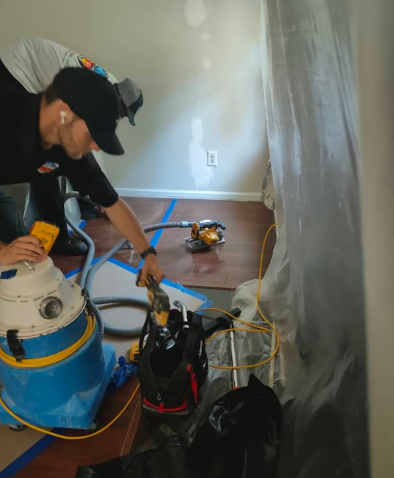
What the daily readings tell a crew on site.
- Whether moisture content is falling, holding steady, or climbing
- Where a hidden source is still feeding water into the area
- When equipment should be repositioned to target slow drying spots
- Which materials are recovering and which are headed for removal
- When the chamber conditions need adjusting to keep drying moving
- When the structure has reached the dry standard and equipment can come out
A reading that stops dropping is the most useful signal on the job. It almost always means something is still wet behind the surface or the source was never fully stopped.
Why Dry to the Touch Is Not Dry
Surfaces dry first and fastest. Drywall facing a room can feel completely normal while the gypsum core and the framing behind it hold enough water to support mold growth, and in Jacksonville humidity that gap closes slowly. Carpet works the same way, with the face fibers drying while the pad underneath stays saturated.
This is where meters earn their place, because the only way to know is to measure. Closing a wall that reads above the dry standard traps moisture against framing and insulation, and the problem reappears weeks later as odor or staining with no obvious cause. Timelines vary with how much material got wet and how deep it went, which is covered in more detail in how long drying takes after a loss.
How We Document Readings for Insurance
Every reading our technicians take gets logged against the point and the date, which produces a drying record rather than a conclusion. Carriers want evidence that the structure reached a dry standard, and a daily log of moisture content showing the curve from saturated to dry is the strongest form that evidence takes. A job documented this way also protects the property owner later, since the record shows what was wet, what was dried, and what had to come out.
Keeping the readings and the claim with one team removes a common friction point. Our office bills insurance carriers directly, so the moisture log, the photographs, and the scope of work travel together to the adjuster instead of being assembled from several vendors after the fact. Properties across Duval, Clay, St. Johns, and Nassau counties get the same documentation standard regardless of job size.
If a Jacksonville property has been wet and nobody has taken a reading, you do not yet know whether it is dry. Call (904) 312-7990 for 24/7 response from IICRC- and IRI-certified technicians.
Related Topics:
- How Can Roof Leaks Cause Water Damage in Jacksonville, FL?
- Can Water Damage Weaken Your Home’s Structure in Jacksonville, FL?