



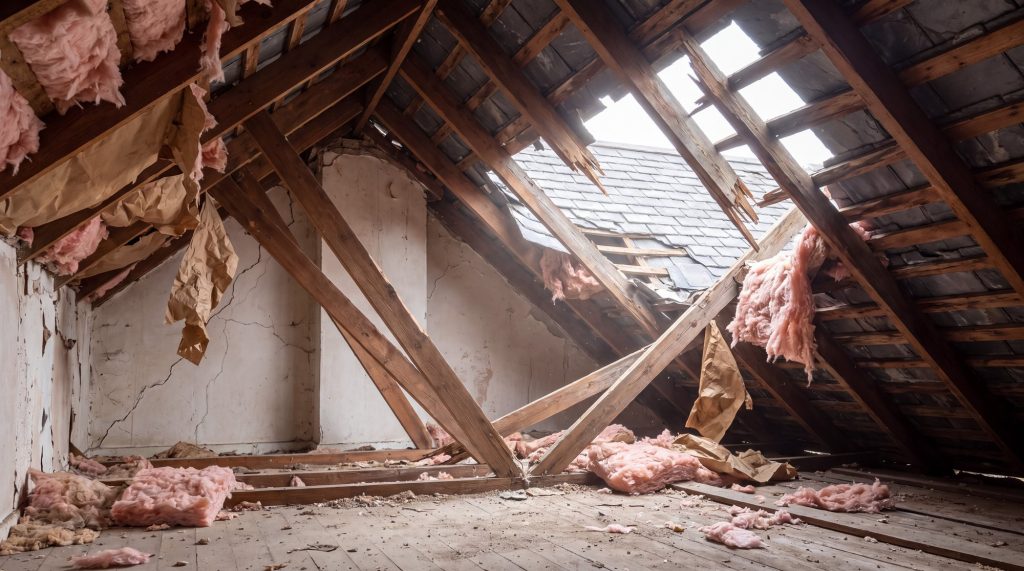
Wet insulation stops insulating almost immediately, and in most cases it just does not recover. Batt insulation compresses under the weight of the water it holds. It loses the trapped air that gave it any value, then stays damp inside the cavity long after the drywall surface feels dry.
Our crews meet this on nearly every attic and wall loss we take. We read moisture in the cavity rather than at the surface, which is a bit slower but kind of the whole point.
Any reputable water damage restoration company in Lakeland, FL checks that cavity because skipping it leaves the building’s wettest material in place. Ask any contractor how they intend to check behind the wall.
Why Wet Insulation Rarely Dries in Place
Insulation works by holding still air, and water displaces that air the moment it arrives. Fiberglass batts sag and pack down under the weight, which permanently reduces their thickness. Cellulose behaves worse. It absorbs readily, clumps, then settles into the bottom of the cavity and leaves the upper wall with no coverage at all.
Neither material returns to its original performance after a soaking, which is why replacement, followed by reconstruction and rebuild services, is usually the honest answer.
Position makes the drying problem harder still. Insulation sits inside a sealed cavity with drywall on one face and sheathing on the other, so almost no air moves across it. Air movers pointed at a wall dry the paint, and that is about it. The material a foot behind that paint can hold moisture for weeks while growth takes hold. In Lakeland humidity, that window is measured in days.
What Happens to the Materials Around It
Wet insulation does not sit quietly. It holds moisture directly against the back of the drywall and against the framing, keeping both wet long after the floor has dried.
Paper facing on batt insulation gives growth something organic to feed on, and the paper backing on the board it touches does, too. The result is a cavity that stays warm, dark, and damp, exactly what happens when water damage goes untreated.
Framing takes the longer-term hit. Studs and bottom plates in prolonged contact with saturated insulation hold that moisture alongside it. Wood that stays wet eventually softens and loses strength, and fasteners corrode in the same conditions. None of this shows from inside the room, which is how a property passes a casual look while deteriorating behind the wall.
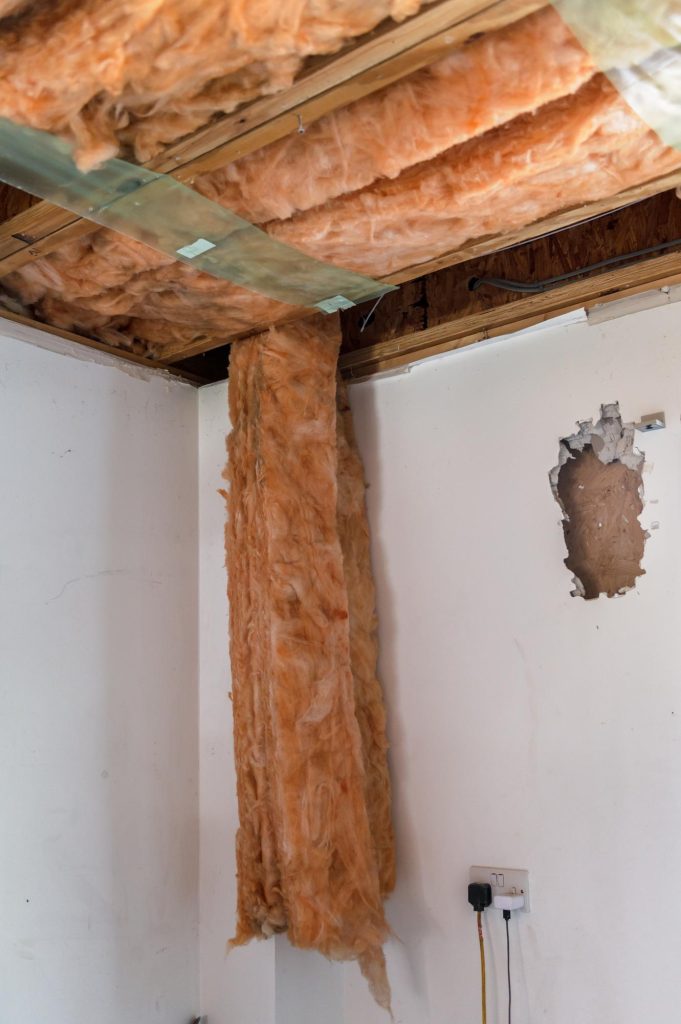
How to Tell Whether Insulation Behind Your Wall Is Wet
You just cannot tell by looking at the wall, and that is kind of the uncomfortable part. There are reliable secondary signs, though, and most can be checked without opening anything, which is one of the simplest ways to reduce the risk of future water damage.
- A musty smell that returns in one room. Odor concentrates where the moisture is, especially when the air conditioning cycles on.
- Drywall that feels cool or soft near the floor. Moisture wicks upward from the bottom plate.
- Visible sagging or a bulge in the wall surface. Packed down insulation pulls the board with it.
- A higher cooling bill after a leak. Compressed insulation stops performing, and the system works harder.
- Ceiling stains that grow or darken over several days. Attic insulation is holding water and releasing it slowly.
Noticed a musty smell, a soft patch of drywall, or a stain that keeps growing after a leak? Give us a call at (863) 333-9865, and we’ll read the moisture in the cavity and tell you plainly what has to come out.
What Removal and Replacement Actually Involves
Opening a wall is not the aggressive option. It is the controlled one. Technicians cut above the water line, pull the affected insulation, and expose the cavity so framing and sheathing dry with real airflow across them.
Material that absorbed contaminated water goes into containment for disposal. A clean cut line also gives the rebuild a straight edge, which keeps the patch invisible once it is finished.
Drying runs before anything closes back up, and that order is not negotiable. Air movers and commercial dehumidifiers hold the environment dry enough for moisture to leave the framing.
Readings are logged daily until the numbers hold steady at a dry standard. New insulation goes in after that, not before. Our rebuild crews then close the wall, finish the drywall, and match the existing paint.
Attics follow the same sequence with one addition. Attic insulation sits loose across the ceiling, so contaminated material comes out in full across the affected run rather than in a neat rectangle. The decking above it gets checked at the same time. Skipping that leaves damp material sitting on the ceiling board of the rooms below.
Does Insurance Cover Insulation Replacement?
Coverage usually tracks the cause of the water rather than the material it damaged. A sudden event such as a failed supply line or storm-damaged roofing is commonly covered.
Insulation replacement then falls inside the repair half of the claim, alongside drywall and paint. Gradual seepage from a leak that ran unnoticed for a long period is treated differently by most policies, and some exclude it outright.
What helps either way is evidence, captured before anyone starts cutting. Photographs of the wet material in place, moisture readings with dates attached, and a written scope all give your adjuster something concrete.
We produce all three as standard and hand them over with the file. Check your own policy wording on sudden against gradual damage, or ask your agent. That distinction decides more of these claims than the size of the loss.
Keeping It from Happening Again
Most insulation losses trace back to something small that ran for a while. A supply line fitting weeping behind a vanity. A roof penetration that lost its seal. An air handler drain line that backed up and overflowed into the ceiling. None of those announce themselves, and all of them are catchable on a routine look.
Twice a year is enough for most Lakeland properties, ideally before hurricane season and again once it closes. Check under every sink and look at the ceiling below the air handler. Then put your head into the attic with a light and scan for staining on the decking and matting in the insulation. It takes maybe twenty minutes, and it is a lot cheaper than opening a wall later.
Not sure what is sitting inside your walls after a leak? Contact us or call (863) 333-9865, and our Lakeland team will read the moisture and hand you a daily log for your adjuster. You can also find us at 3928 Anchuca Dr. #6, Lakeland, FL 33811.
Related Topics: