



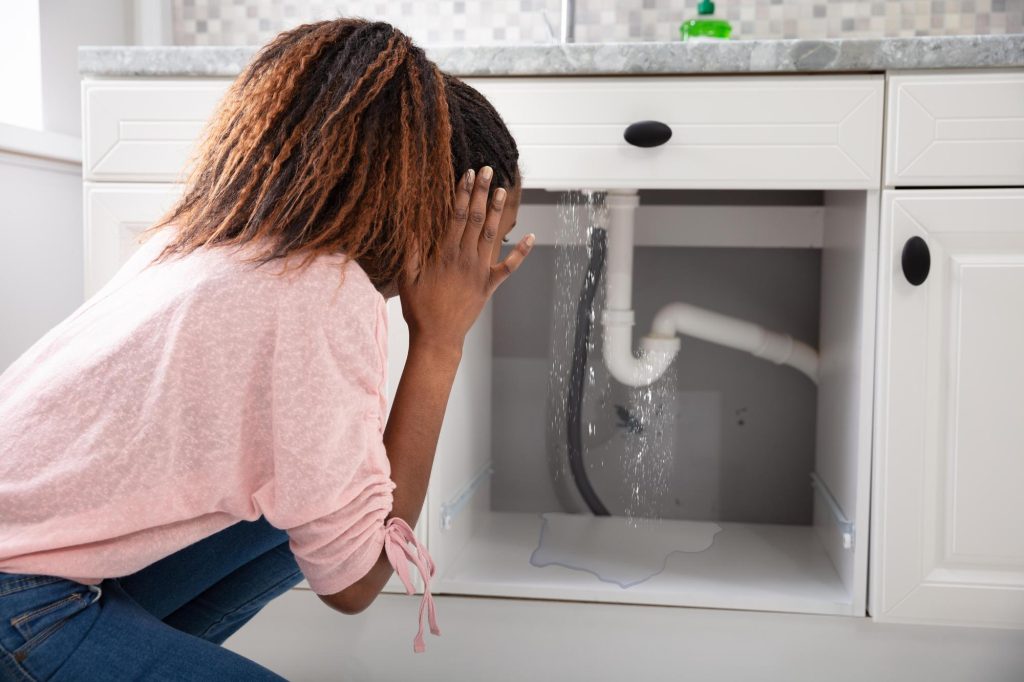
Nearly every case we open traces back to one of five points. Those are the drain trap joints and the hot and cold supply connections. The others are the garbage disposal seal, the faucet base seal, and the dishwasher drain hose. A drip at any of them lands inside a closed cabinet, and honestly, nobody opens that cabinet except to grab dish soap.
We’ve been doing trusted water damage repair in Jacksonville, FL since 2011, and our IICRC-certified technicians bring moisture meters into these kitchens for one simple reason: the cabinet floor is almost never the only wet thing left.
So just put a dry paper towel under each joint and run the tap for a couple of minutes. Whichever towel comes back damp, that’s your answer.
Why Under Sink Leaks Go Unnoticed in Jacksonville Homes
The cabinet under a kitchen sink is an enclosed box holding live plumbing, and it stays shut all day. A supply line weeping a few drops an hour puts out less water than a dripping faucet. There’s no puddle to step in and nothing to hear over a running dishwasher. The water soaks into the particleboard cabinet deck, which drinks it and holds it.
That slow pace is what makes these losses expensive, kind of ironic, really. A burst supply line floods a kitchen in an afternoon, and that’s usually when people want to know what happens during an emergency water damage response, since the call comes in within the hour.
A pinhole at a compression nut, on the other hand, can run for six or eight weeks before the deck swells enough to notice. The water eventually finds the gap where the cabinet meets the wall. We’ve opened cabinets where the visible damage is a dinner-plate-sized dark ring, then pulled a reading four feet away in the next room and found the subfloor soaked through.
Which Connections Under the Sink Fail Most Often?
Knowing which part gave out changes what happens next, and it’s worth knowing before you call anyone. A pressurized supply line and a gravity drain behave pretty differently once they start leaking.
Pressurized lines push water out continuously, whether or not anyone’s even home. Drain lines, on the other hand, only leak while the sink is running. A drain leak can hide through a whole quiet work week, then announce itself on a Saturday full of dishes.
Here’s what our crews find when they trace the source back.
| Failure point | How it usually presents | Why it spreads |
| Supply line nut or braided hose | Steady damp, worst at the back wall | Pressurized, runs continuously |
| P-trap slip nut or washer | Damp only after the sink drains | Drips directly onto cabinet deck |
| Garbage disposal gasket | Ring of damp under the unit | Carries food solids, contaminates fast |
| Faucet base or sink rim seal | Water tracks down the cabinet back | Enters from above, bypasses the deck |
| Dishwasher drain hose connection | Damp toward the dishwasher side | Hot, soapy water speeds swelling |
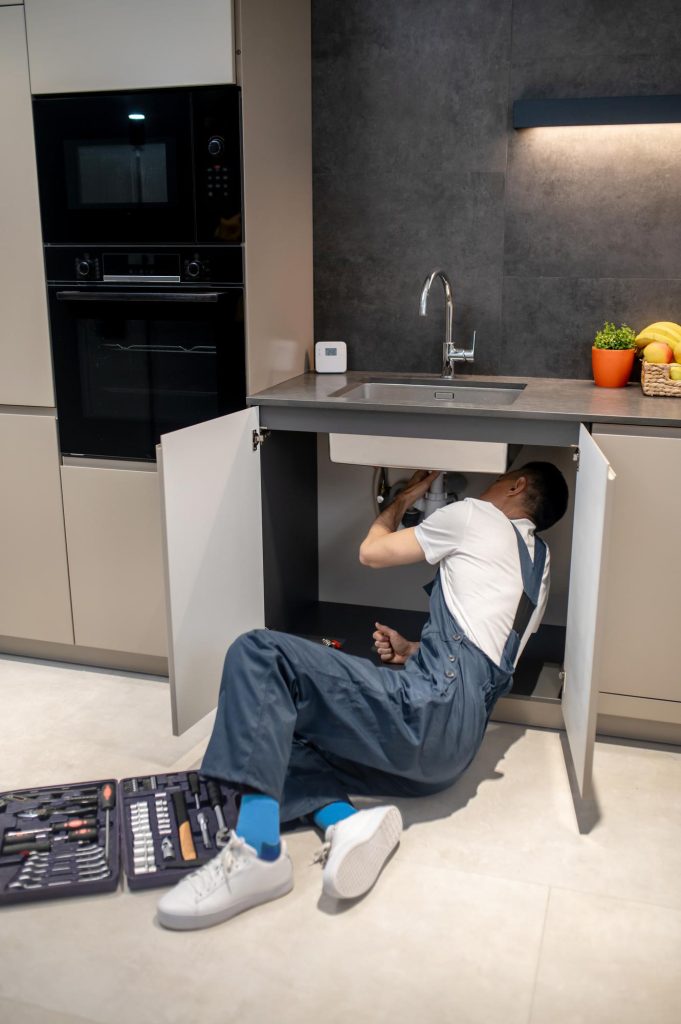
A plumber owns the repair of every item in that table, that part’s not really our job. What is our job, through leak detection and repair, is finding the source when nothing’s visible from inside the cabinet. The restoration side is a separate question, covering everything the water touched on its way out.
How Jacksonville Humidity Turns a Slow Drip Into a Mold Problem
Materials dry out by giving moisture back to the air around them, and that only works if the air actually has room to take it. Our summers run humid enough that a damp cabinet deck inside a closed box has nowhere to send what it’s holding. The same leak in a drier climate might sit there and do, well, almost nothing. Here, it just stays wet. And warm.
Mold growth can begin within 24 to 48 hours on wet organic material, which honestly isn’t a lot of time. A particleboard deck under a laminate skin is close to ideal for it. The laminate traps moisture against the board, so the top looks fine while the underside goes soft underneath.
In a two-story home, that same moisture can travel and show up as a stain on the ceiling below, which is one of the warning signs of ceiling water damage people tend to miss. That’s usually the point where a homeowner calls us about a smell rather than a leak, and the smell’s usually been there a while before anyone names it.
How Do You Spot Under Sink Water Damage Early?
Most of these losses announce themselves long before the cabinet actually fails, as long as somebody bothers to look. The cabinet under the sink is worth a quick two-minute check every few months, maybe when you’re grabbing the trash bags. What you’re looking for is pretty specific, not just a general “does it look wet” glance.
- A musty smell when the cabinet door opens, before any stain is visible
- Dark or blistered edges on the cabinet deck, especially at the back corners
- A soft spot that gives slightly under thumb pressure near a pipe
- Rippling or lifting in the flooring just outside the cabinet toe kick
- Rust or mineral crust on a shutoff valve, which marks a slow weep
Stains on the ceiling below a second-floor kitchen belong on that list too, and they’re easy to miss if you’re not looking up as often as you’re looking down.
Noticed any of these signs under your own sink, or maybe just a musty smell you can’t quite place? Give us a call at (904) 312-7990, and we’ll take a look before it turns into a bigger repair.
What to Do in the First Hour After Finding Water Under the Sink
Shut the water off at the two angle stops under the sink, turning them clockwise until they stop. If a valve’s seized up or weeping at the stem, just go to the main shutoff instead of forcing it. Pull everything out of the cabinet and set it somewhere dry. Cardboard and paper wick water sideways, by the way, and will keep feeding the deck even after the leak stops.
Towel up the standing water, then leave the cabinet doors wide open. Resist the urge to point a box fan into a cabinet that already smells musty, it won’t help. Moving air across colonized material just spreads spores through the rest of the kitchen.
Photograph the cabinet, the wet floor, and the failed part before any repair happens, since a carrier will ask what the condition was at discovery. If the water came through a disposal or a dishwasher drain, treat it as contaminated and keep dishes well away from it.
For that reason, our crews document moisture readings on the first visit, and yes, we bill carriers directly.
When a Plumber Is Not Enough, and a Restoration Crew Is
A plumber stops the water, that’s the easy part. Drying the building out is a different job entirely, and the split confuses people because both trades end up in the same cabinet. Say the leak got caught the day it started, and the cabinet deck is the only damp thing. A towel and an open door often finish the job.
The line gets crossed once water leaves the cabinet. Readings in the wall cavity, a soft subfloor, flooring lifting in the next room, these all point the same way. So does a smell that survives the repair.
Materials are holding water that air alone just won’t pull out. At that point, the work becomes extraction, controlled drying with dehumidifiers and air movers, and sometimes pulling the lower cabinet out to reach behind it.
Our technicians run thermal imaging to map how far the water actually traveled before deciding what comes out. Guessing at that boundary is how a kitchen ends up getting opened up twice, and that’s exactly the kind of call worth making early.
Frequently Asked Questions
Damage starts almost immediately on particleboard, which soaks up water within hours, not days. Structural concerns and mold growth usually need 24 to 48 hours of sustained moisture to really take hold. A slow weep running for weeks can actually do more total harm than a fast leak caught the same day, mostly because nobody’s there to interrupt it.
Most policies cover sudden and accidental discharge, like a supply line that suddenly fails. Damage from a gradual leak that was visible for a long period is often excluded as a maintenance issue instead. Document the discovery with photos and call your carrier early, and we can help you with the claim directly.
Solid wood cabinet boxes can often be dried out and saved, no problem. Particleboard and MDF that’s already swollen and delaminated has lost its structure, though. It won’t return to shape, so those usually have to come out. A moisture reading taken before any demolition is really what settles the question.
Bleach addresses surface discoloration on hard materials, sure. But it doesn’t remove growth from inside porous board, and it actually adds more water to a cabinet that’s already wet. Removing the affected material and drying the cavity out is what actually resolves it.
Contact Us
Found water under your kitchen sink in Jacksonville, FL? Call us at (904) 312-7990 for a free assessment, or contact us and we’ll walk you through the next steps.
Our certified technicians answer 24 hours a day, every day of the year. We’ll get a moisture reading on your cabinet and subfloor before you decide what needs replacing. We’re located at 9556 Historic Kings Rd S STE 404, Jacksonville, FL 32257.
Related Topics: